From sensory storytelling to hype-worthy drops, beauty brands have turned social media into a cultural engine—and any industry can steal their strategies.
Beauty brands aren’t just posting on social — they’re pioneering. To see what’s next in social for brands, look to the many innovators in the category. They’ve turned social media into immersive narratives, sensory playgrounds, cultural zeitgeist, and commerce engines that every industry should study (and steal). By blending culture, creativity, and commerce, beauty brands are setting a standard every industry should study. The good news? When you look closely at what makes these brands great, they are applying principles that can elevate any brand’s social presence, regardless of industry. Let’s break down the beauty social playbook that every brand should steal.
Make Content a Multi-Sensory Experience
When brands tap into the senses, they are engaging parts of the brain tied to nostalgia, comfort, and pleasure. Right now, no one is doing sensory content better than beauty brands. In today’s world, where consumers are discovering and buying new beauty products digitally, brands are finding creative ways to activate all five senses through your screen (and even bringing those sensory experiences to life in the real world). The best part? There’s more than one way to do it:
- Laneige leads with food-inspired activations—like Cream Skin Cafés, collabs with Sidecar Doughnuts and Boba Guys, and flavor-forward lip masks—that bring the product to life through taste and texture.
- Rare Beauty’s Tajín collab turned a lip oil launch into a full sensory experience, blending bold color with the tangy, spicy flavor that fans could literally taste. It wasn’t just a launch; it was a cultural crossover moment that lit up TikTok and drove sellouts.
- Rhode has long used sensory and food-based marketing as an always-on social strategy. From a Krispy Kreme strawberry glazed donut collab and serving up product content alongside craveworthy food to close-up texture shots and soothing sound design, you can practically feel and smell the product through the screen.
By tapping into smell, taste, texture, even sound, brands are able to both tell consumers exactly what to expect from their products and deepen emotional connection by triggering memories and feelings that make the brand experience stick.
Master the Art of “The Drop”
Scarcity, hype, surprise. Product drops aren’t new, but beauty brands are staging them with finesse. Product launches used to be press releases and shelf resets. Now, they’re drops that have consumers setting reminder notifications and waiting in virtual lines. Beauty brands have mastered the art of anticipation: countdown clocks, creator previews, drip-fed teasers, and early-access exclusives that drive urgency and FOMO. Scarcity and urgency turn the simple act of buying into a shared social ritual.
- Take Rhode’s limited-edition launches: they tease with cryptic campaign imagery, build waitlists, let creators and influencers preview shades, and then drop product with a “be quick or you’ll miss it” urgency. Every step fuels conversation and user-generated content, leading to sellouts within hours and comments from customers begging for restocks.
- Fenty Beauty set the standard with its foundation shade expansions—positioning each as a cultural reset moment that demanded coverage beyond beauty press.
- Glossier has mastered the art of the drop with a constant pipeline of surprise drops (like Balm Dotcom flavors) to mobilize superfans and create micro-frenzy. They build up hype as consumers guess what’s coming next and even extend the hype IRL as they use activations to continue to drive social conversation and content.
- Even drugstore brands are catching on: e.l.f. Cosmetics’ limited-edition collabs (like the Chipotle or Dunkin’ partnerships) are hyped on social as collectors items, with fans racing to Target before stock disappears.
Other industries should take notes: drops can turn what would have been a quiet launch into a buzzy, high-stakes, social-first cultural moment that lives far beyond the release day.
Turn Creators (and Fans) into Co-Authors
Collaboration is no longer a marketing stunt–it’s a growth strategy. Beauty brands have moved past simply activating the standard “beauty influencer playbook.” Beauty brands are pulling in unexpected partners and letting creators co-author the story. They’re inviting creators into the room, handing them the mic, and letting authenticity lead. Beauty brands are bringing this strategy all the way down to their community of fans where passion matters more than follower count. As 65% of young consumers prefer recommendations from small creators, brands are seeing the highest return from partnering with people already immersed in communities or fans of the brand–offering higher authenticity and trust (YPulse, Glossy).
- Refy has shifted from a traditional influencer approach to empowering their customers to become influencers. From featuring 1,000 faces of their customers in a concealer campaign and trading in “influencer trips” for intimate retreats for customers, they have turned their customers into active participants in the brand.
- Many beauty brands are stepping into more unexpected collabs and partnerships outside of traditional beauty influencers. Where are they going? Women’s sports. e.l.f. inked a sponsorship with the NWSL and several female athletes from other sports. They even had a group of creators run and chronicle the London Marathon in their setting spray. In the WNBA, Urban Decay partnered with the LA Sparks and Cameron Brink, and nail polish brand Essie gave the New York Liberty’s mascot Ellie the Elephant her first beauty sponsorship.
- Social has become a powerful tool for beauty brands to listen to their customers, iterate on products, and develop new ones. Brands like Merit actively rely on their communities on product development–even inviting hundreds of users of social to participate in tests for their new moisturizer. Glossier regularly brings back or launches new products based on fan requests.
Fan collaboration and creator partnerships extend the brand beyond the product, into lifestyle and identity. They spark new conversations, invite fans into the creative process, and earn trust by letting real voices lead.
Expect to see deeper co-creation, where creators are not just part of the marketing, they’re in the briefing room. Think limited-edition products designed with creator input, “drop squads” made up of top fans who preview and promote launches, and community voting that decides which collabs make it to market.
Entertain, then Educate
Beauty and skincare consumers are more discerning, selective, and knowledgeable than ever. They don’t want to just know what a product is and does, but what is in the products they are using, how they work, and more about the brand they are buying them from. 58% of young women (13-39-years-old) agree, “I pay attention to the ingredients in the beauty/personal care products I buy.” At the same time 58% of women 18-24 say the reason they wear makeup is “for fun” (YPulse). This is why blending entertainment with education wins big for beauty brands on social.
- Tower28 Beauty created a sketch comedy show “The Blush Lives of Sensitive Girls” where each episode highlights a unique selling point of the brand’s new GetSet Blush in a way that is truly entertainment first.
- Skincare brand Byoma breaks down complex science into fun, accessible content for Instagram, that keeps education light and easy to digest.
- Mary Kay taught a younger audience about their brand, debunking common misconceptions with a fun and sassy brand character.
Education packaged as entertainment keeps people watching and wanting more. The payoff? A more informed, more confident customer who’s ready to click ‘buy.’ What’s next for edutainment isn’t just more tutorials, but a continued reimagining of how people learn about products.
The Blueprint Is Bigger than Beauty
Beauty brands aren’t just “good at social.” They’ve created a blueprint for blending culture, commerce, and creativity into content that drives conversation and conversion.
For any industry the playbook is there: create sensory experiences, treat launches like drops, co-author culture with creators and fans, and deliver value through entertaining education.
The future of social is about creating moments that matter. Brands that borrow from beauty’s playbook will stop being an interruption in the feed and start becoming part of social culture.
Smart Brands in the $1.1T Wellness Market Are Turning Complexity Into Consumer Confidence
Regulatory complexity isn’t a barrier; it’s a trust-building advantage. Smart brands turn FDA changes into confident consumer connections.
What if the biggest disruption to the wellness industry isn’t a superfood or exercise trend—but a regulatory evolution that’s fundamentally transforming consumer relationships with brands?
The FDA’s sweeping 2024-2025 changes—from the Human Foods Program overhaul to stricter ingredient disclosures—are transforming how Americans shop for wellness products. Beneath this transparency lies a fascinating paradox: today’s consumers are no longer following Instagram trends blindly; they’re asking, “What does the science say?” This shift towards evidence-based decision-making is transforming a $1.1 trillion market where, according to recent Advantage Solutions research, 93% of American consumers are actively pursuing healthier lifestyles.
The resulting tension creates unprecedented opportunity: consumers demand transparency yet feel less confident amid more information. While a whopping 86% hesitate to share their health data, 50% still welcome personalized recommendations from brands they trust. Smart companies are catching on—viewing regulatory shifts not as hurdles, but as tools to build trust. By delivering evidence-backed personalization that safeguards privacy, they’re turning compliance into confidence, the most valuable currency in today’s wellness economy.
Key Trends + FDA Changes = Marketing Opportunity
Consumer wellness trends and FDA regulations are creating unprecedented marketing potential for brands that understand their intersection.
Biohacking Meets Regulation: Consumers with Oura rings track their sleep and monitor their stress with wearables, yet still question whether supplements meet regulatory standards. Opportunity: Position your brand as the trusted translator, connecting personal health data to compliant, science-backed products with a “Biohack with Confidence” message. This trust is essential: while 65% of consumers rely on healthcare professionals for health information, 40% also turn to social media, highlighting the need for credible, digestible guidance.
Gut Health Embraces Standards: 43% of consumers prioritize gut health as their top wellness concern¹ with 38% taking probiotic/prebiotic supplements¹ while the FDA reviews 21 food chemicals, including several that can impact digestive health.³ Opportunity: Create state-specific educational content showing which ingredients deliver results while meeting regulatory requirements.
Mental Wellness Navigates Claims: With 73% of consumers using exercise to manage stress and 36% practicing meditation, breathwork and vagus nerve stimulation are surging alongside stricter FDA stance. Opportunity: Showcase experiences and let customer testimonials carry effectiveness messaging.
GLP-1 Finds Compliant Partners: Wegovy users need supplement guidance without explicit interaction claims. Opportunity: Develop “GLP-1 compatible” positioning similar to “keto friendly” labeling.
Longevity Verification Emerges: With 78% of consumers taking supplements for “general health and wellness” rather than specific concerns, preventative health grows while GRAS system scrutiny increases. Opportunity: Create “longevity-verified” credentials that exceed minimum requirements.
Privacy-Forward Personalization: Although only 14% of consumers currently share their health data, personalization continues to drive engagement and loyalty. Opportunity: Empower consumers with transparency and choice, letting them control which data informs their wellness recommendations to build trust through consent.
Omnichannel Standards Build Trust: Consumer shopping spans multiple channels, with 72% purchasing at mass retailers, 40% at drug stores, and 18% shopping online¹—highlighting the need for comprehensive omnichannel regulatory storytelling. Ecommerce grew 6.4%⁵ while 74% buy based on trusted recommendations.⁶ Opportunity: Create unified compliance storytelling across digital (deep information), in-store (immediate reassurance), and social (peer verification) that maintains consistent regulatory messaging across all retail touchpoints.
Practical Nudgenomics™ for the FDA Era
Nudgenomics™—the intersection of behavioral science and shopper psychology— helps brands turn regulatory complexity into a competitive edge. By deploying smart nudges, brands can build trust, reduce friction, and drive informed action.
Social Proof at Decision Points: Given that 53% of consumers say they get health information from friends and family/peers, place customer “compliance testimonials” precisely where 69% of consumers pause for additional research, showing real people discussing both safety confidence and results.
Simplification Tools: Combat regulatory decision fatigue with visual ingredient translators and interactive guides. Brands using these tools see 28% higher conversion in regulated categories.
Authority Bias Activation: With 65% of consumers looking to healthcare professionals for health information,¹ brands can leverage this natural deference to authority by incorporating credible medical or regulatory experts in messaging around compliance. Prominent “FDA aligned” or “physician reviewed” credentials can transform regulatory adherence into a premium positioning signal that reduces decision anxiety.’
Compliance-Enhanced Trends: Connect regulations to trending behaviors, like magnesium for sleep (up 44% in discussions). Position compliance as enhancing effectiveness rather than restricting choices.
These examples of nudges are opportunistic to convert regulations from constraints into advantages that build confidence and drive loyalty.
The New Reality: Complexity as Competitive Advantage
The wellness industry challenge is simple: build consumer confidence amid shifting regulatory ground. Every FDA mandate is a trust-building opportunity. The brands that transform confusion into clarity will capture loyalty in the $1.1 trillion wellness market.
Regulatory complexity isn’t going away. The real question is whether your brand offers solutions or adds to confusion. The winners won’t see requirements as hurdles but as highways to deeper consumer connections—helping people feel informed and confident even as rules evolve.
Ready to take your brand’s commerce practice to the next level? Let’s talk.
A Strategic Playbook for Winning Beauty Commerce in 2025
The beauty counter has moved from the department store to the palm of your hand. According to our 2024 Social Commerce Beauty Study – which surveyed more than 5,000 U.S. consumers – 58% of social media shoppers are now purchasing beauty products directly on their favorite platforms, making beauty the second-most purchased category in social commerce. This isn’t just a trend—it’s an unprecedented transformation of how consumers discover, evaluate and purchase beauty products in a fundamental way.
As social commerce races toward sales projected to grow 22% and reach over $101B in 2025 (eMarketer, 2024), beauty brands face a critical inflection point. Those who master this new digital beauty counter will thrive; those who don’t risk losing connections with an increasingly social-first consumer base. We’ve identified the key strategies to separate winners from observers in this rapidly evolving landscape.
The Rise of Social Commerce
Platforms like TikTok, Instagram and Facebook have revolutionized how beauty shoppers discover and purchase products. The impact of this transformation was evident during the 2024 holiday season when, according to Retail Dive, TikTok Shop’s Black Friday sales exceeded $100MM—with beauty emerging as a standout category.
Our 2024 Social Commerce Beauty Study reveals Instagram as the leading platform for beauty purchases, with 71% of social beauty shoppers making purchases through the platform, showcasing its dominance in influencing beauty commerce.
According to our 2024 Social Commerce Beauty Study (n=480):
Social Media Platforms Most Used by Social Beauty Shoppers
- Facebook (91%)
- Instagram (90%)
- TikTok (78%)
- X (formerly Twitter) (53%)
- Pinterest (46%)
- Snapchat (41%)
Social Media Platforms Used to Buy Beauty Products
- Instagram (71%)
- Facebook (59%)
- TikTok (53%)
- Pinterest (24%)
- X (formerly Twitter) (21%)
- Snapchat (17%)
Strategic Focus
- Platform-specific Insights: Understanding unique platform behaviors is crucial. For example, TikTok excels at discovery, while Instagram drives inspiration and conversion.
- Actionable Tip: Create platform-specific content that mirrors the native user experience to boost engagement and sales.
The Collapsed Shopper Journey
Social commerce has streamlined the customer journey, allowing shoppers to discover, evaluate and purchase products in seconds. Our 2024 Social Commerce Beauty Study highlights this shift, revealing that more than half of social beauty shoppers (54%) enjoy discovering new beauty products on social media, while 28% appreciate the ability to check out directly within social platforms.
According to eMarketer’s latest research, platforms like TikTok are accelerating the path to purchase by enabling content creators to embed product links from third-party retailers directly in posts, creating new opportunities for beauty brands and retailers to partner on social commerce programs.
What Social Beauty Shoppers Value Most
- Discovery: Engaging visual content from influencers and brands
- Evaluation: Social proof through reviews, comments and live demonstrations
- Purchase: Seamless, in-platform checkout options
Our 2024 Social Commerce Beauty Study Reveals Key Preferences
What Social Beauty Shoppers like about shopping for beauty products on social media
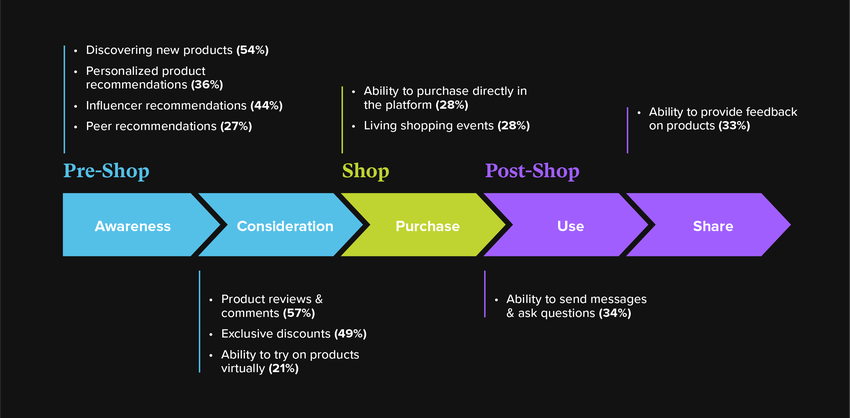
Strategic Focus
- Optimize the Journey: Layering purchase paths ensures accessibility and personalization across diverse shopper segments. Each touchpoint—from inspiration to purchase—should be seamless.
- Actionable Tip: Invest in content formats like live shopping events and shoppable posts to cater to multiple stages of the journey.
Beauty Content that Converts
According to our 2024 Social Commerce Beauty Study, beauty shoppers are heavily influenced to purchase beauty products on social media through authentic connections and visual storytelling—ranking these factors ahead of exclusive offers and discounts (37%) and expert endorsements (19%).
The power of social proof emerges as a dominant force in purchase decisions, with our research showing 67% of beauty shoppers rely on reviews to make their choices. User comments (48%) provide an additional layer of credibility, while influencer recommendations (44%) help validate product efficacy and demonstrate real-world results.
Engaging visual content proves equally crucial in driving conversion. Our study reveals that high-quality product images influence 51% of beauty purchases on social platforms, while dynamic videos impact 46% of buying decisions. Product demonstrations, which bridge the gap between online shopping and in-store experiences, influence 41% of social beauty purchases.
Strategic Focus
- Create to Convert: Leverage short-form videos, interactive tutorials and user-generated content to build trust and drive sales
- Actionable Tip: Incorporate strategic influencer partnerships to amplify authenticity and reach.
#TrendingIn2025
Our 2024 Social Commerce Beauty Study reveals that social beauty shoppers are looking forward to making proactive, informed and mindful decisions going into 2025 to set up themselves, their skin and the planet for the best possible results.
Our comprehensive research identifies clear priorities among social beauty shoppers for 2025, with clean beauty at the top of their list with 56% of respondents expressing strong interest. Sustainability emerges as a key driver, with 47% of shoppers prioritizing eco-conscious products. The study also highlights a significant focus on preventative skincare (44%), while both beauty tech innovations and ingredient transparency tie at 39%, showing the dual consumer interest in both advancement and authenticity.
Trends beauty social commerce shoppers are most excited about in 2025:
- Clean Beauty (56%)
- Sustainable Products (47%)
- Preventative Skincare (44%)
- Ingredient Transparency (39%)
- Beauty Tech Innovations (39%)
Strategic Focus
- Transparency & Trust: Social beauty shoppers demand ethical, sustainable and effective beauty solutions.
- Actionable Tip: Highlight credentials, ingredient sourcing and sustainability initiatives in your 2025 social commerce content.
The Social Commerce Imperative
The convergence of social media and commerce has fundamentally transformed beauty retail. With 70% of the U.S. population (239 million people) actively using social platforms (DataReportal, 2024), these channels are now essential for brand growth. Social platforms deliver unprecedented advantages through captive audiences, personalized recommendations and authentic two-way engagement. The transparent ecosystem of reviews and realtime feedback enables confident and informed beauty purchasing decisions.
Your Partner in Social Commerce
We deliver comprehensive solutions across the social commerce ecosystem. We help brands optimize their presence through platform-specific campaigns, seamless shopping experiences and content strategies that drive measurable results. Through strategic planning and proven execution, we enable beauty brands to capitalize on emerging opportunities—from livestream shopping to AI-powered personalization. Most importantly, we understand how to translate beauty’s core values and trends into compelling and effective social commerce experiences that resonate with today’s digital-first consumer.
For complete findings from our 2024 Social Commerce Beauty Study, including platform analytics, demographic insights and trend forecasts, contact our team to discuss strengthening your brand’s digital presence in 2025.
Sources
- Our Social Commerce Survey, 12/12/24, N-5001, Beauty social shoppers, N=1541
- EMARKETER: 5 charts on the holiday social commerce opportunity, 10/7/24
- Retail Dive: TikTok Shop sales surpass $100M on Black Friday, 12/11/24
- Our Social Commerce Survey: Q2: Which of the following social platforms do you regularly use? 12/13/24, N-428
- Our Social Commerce Survey: Q3: Which social media platforms have you used to make a beauty purchase? 12/13/24, N-423
- Our Social Commerce Survey: Q4: What do you like about shopping for beauty products on social media? 12/13/24, N-380
- Our Social Commerce Survey: Q5: What factors influence your decision to purchase beauty products on social media? 12/13/24, N-379
- Our Social Commerce Survey: Q6: What beauty trends are you most excited about in 2025? 12/13/24, N-378